
New Hampshire winters don't politely wait for the weekend. They show up on Tuesday morning before your first coffee, when the driveway is glassy and the kids need to be at school in twenty minutes. For buyers in that position, "all-wheel drive" isn't a marketing feature — it's a specific engineering choice that decides whether the rest of your day happens on schedule.
At our lot on Candia Road we see a steady rotation of AWD sedans, crossovers, and SUVs in the $10,000–$15,000 range. Below are six models we recommend again and again for commuters, families, and first-time buyers in the state. We'll also cover what to inspect before you buy, the part everyone overlooks (tires), and the honest trade-offs that come with AWD ownership.
Why AWD matters in NH (and why it doesn't, too)
Here's the under-stated truth about AWD: it only helps you go. It does nothing to help you stop, and nothing to help you turn on ice. Both of those jobs belong to your tires. A front-wheel-drive Honda Civic on proper winter tires will out-handle an all-wheel-drive crossover on worn-out all-seasons — every time, no exceptions.
That said, AWD genuinely matters in the situations New Hampshire drivers hit weekly: pulling away from a stop sign on a slushy intersection, climbing a steep driveway after a storm, getting out of an unplowed parking lot at 7 a.m. In those moments, having engine torque sent to whichever wheels have traction is the difference between going somewhere and sitting still. If you live in Goffstown, Candia, Auburn, or anywhere the road crew shows up second, AWD earns its keep.
AWD vs. 4WD — a quick primer
"All-wheel drive" and "four-wheel drive" get used interchangeably, but they're different systems:
- AWD runs automatically in most modern cars and SUVs. The vehicle decides — usually in milliseconds — which wheels need power, and sends it there without the driver doing anything. Great for on-road winter driving.
- 4WD is typically a truck system with a physical transfer case. You select between 2WD (for dry pavement), 4-High (for snow), and 4-Low (for deep mud or rock crawling). It's built for rougher off-road use but is overkill for most daily commutes.
If you want a dependable daily driver that handles snow, you want AWD. If you want a truck that can tow a camper through an unplowed campground, you want 4WD.
What to look for in any used AWD vehicle
- Matching tire tread depth across all four corners. Mismatched tires on an AWD vehicle can damage the center differential over time. If two tires are newer than the others, plan to replace all four.
- Documented service history, especially fluid changes. Rear differential fluid, transfer case fluid, and front differential fluid (if applicable) should be changed periodically. Ask when they were last done.
- CV axle boots — intact, no tears. Torn boots let grit into the CV joint, and replacing a CV axle is a multi-hundred-dollar job.
- No clunks or whines during a test drive. Turn the steering wheel lock-to-lock in a parking lot. Clicking noises during turns usually point to a worn CV joint.
- Rust on underbody components. Salt country vehicles develop surface rust, which is normal; heavy flaking rust on brake lines, fuel lines, or subframes is a red flag.
- Carfax or AutoCheck history. Look for consistent maintenance, no major accidents, and no "branded title" entries.
Every vehicle we sell at FC Motors goes through our "Family Certified" inspection, which covers the above plus brakes, suspension, battery, and a full road test. Brandon Madigan runs our on-site service shop, so anything flagged during the inspection gets resolved before the vehicle hits the front row.
Six used AWD vehicles worth shortlisting
1. Subaru Impreza (AWD is standard)
The Impreza is the sleeper pick of the group. Every trim is AWD from the factory — there's no front-wheel-drive version to accidentally end up with — and the 2.0-liter flat-four is famously understressed. You'll find 2015–2019 models comfortably in the $10,000–$13,000 range with under 100k miles. It's the car we recommend to first-time buyers, college students, and anyone whose budget is tighter than their snow-clearance requirements.
2. Subaru Forester or Outback (AWD is standard)
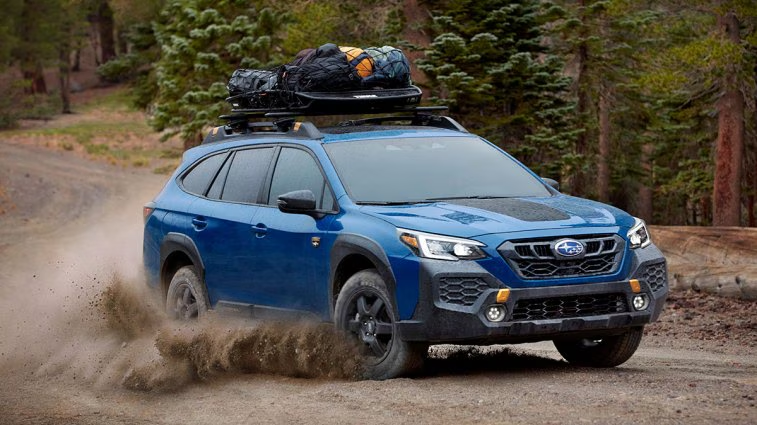
Step up a notch and you're in Forester or Outback territory. Both get Subaru's symmetrical AWD, more ground clearance than most sedans, and genuinely useful cargo space. Older-generation Outbacks (2014–2017) with the 2.5-liter four-cylinder hold up well; avoid the six-cylinder turbo unless the service history is pristine. Expect $12,000–$15,000 for a mid-mileage clean example.
3. Ford Escape (AWD trim)
The Escape is one of the most common small SUVs on the road in New England, and for good reason: it's comfortable, it has generous cargo room for the footprint, and parts are cheap when something does go wrong. Look for the 2.0-liter EcoBoost AWD trim from 2015–2018. The 1.6-liter EcoBoost had some early head-gasket issues that were largely resolved after 2014, but we'd still steer you toward the 2.0. Budget $10,000–$14,000.
4. Ford Edge (AWD)
If you've outgrown the Escape but don't want a full-size SUV, the Edge hits the middle. It's roomier, rides softer on rough pavement, and handles a full load of groceries and a kid's hockey gear without complaint. Look for 2015–2017 AWD models with the 3.5-liter V6 — reliable, punchy, and not nearly as thirsty as you'd expect. $12,000–$15,000 is a realistic range depending on mileage and trim.
5. Volkswagen Tiguan or Atlas (4Motion AWD)
Volkswagen's 4Motion AWD system is under-rated. The Tiguan is the compact option — good for a couple or a small family — while the Atlas gives you a third row and the ability to haul six adults in comfort. We see more Tiguans than Atlases in the sub-$15K range; most Atlases creep above that price until they hit 80k-plus miles. Service history is especially important on these, since VWs reward consistent maintenance and punish neglect.
6. Honda CR-V or Toyota RAV4 (AWD trims)
The dependability benchmarks. An older CR-V or RAV4 with 110,000 miles will generally outlast newer vehicles with 70,000 miles, provided the maintenance records are there. The trade-off is price: because these hold value so well, you're often looking at older model years or higher mileage to fit under $15,000. When we get one in, it usually sells fast — check our current inventory if you're hunting.
Inventory changes constantly
We turn over about 45 vehicles a month. If you're looking for a specific AWD model, call Matt at 603-965-2870 and he'll let you know what's on the lot — or flag you the next time the right one comes through. Showing up at the right moment usually beats waiting for the perfect listing online.
Why your tires matter more than your drivetrain
We said it earlier and it's worth repeating. The single biggest upgrade any New Hampshire driver can make is a dedicated set of winter tires — not all-season, not mud-and-snow, not "three-season." Winter tires are designed with softer rubber that stays flexible in sub-freezing temperatures and tread patterns that bite into snow and slush. They're marked with the 3-peak mountain snowflake symbol (3PMSF) on the sidewall.
A car with FWD and four proper winter tires will genuinely out-stop, out-turn, and often out-climb an AWD vehicle on all-seasons. The physics isn't complicated: drivetrain only controls the power going to the ground; tires control all contact with the ground, in all four directions. If you can only afford one upgrade for winter, choose the tires.
The honest trade-offs of AWD
AWD isn't free. Here's what you're signing up for:
- 1–3 mpg worse fuel economy versus the same car in front-wheel-drive trim. Over ten years that adds up.
- Extra maintenance items — rear differential and transfer case fluid changes every 30,000–60,000 miles depending on the manufacturer.
- Higher tire replacement cost. All four tires need to match; you can't rotate in two new fronts and leave older rears.
- More moving parts to fail. Driveshafts, CV joints, differentials, transfer cases. None common, all potentially expensive.
Our rule of thumb: if you drive on snow at least 15–20 days a year, or you live on a rural or steep road, AWD is worth the trade-offs. If you commute on well-plowed highways in town and rarely leave pavement, a FWD car with winter tires will serve you just as well for less money and better mpg.
How to test-drive for winter
Most test drives happen in fair weather, which is exactly when AWD's benefits are invisible. Here's how to get a useful read on the vehicle anyway:
- In a quiet parking lot, accelerate hard from a stop on loose gravel or wet pavement. Does the vehicle feel planted? Any unusual shudder or hesitation as power transfers to the rear wheels?
- Drive at highway speed and feel for vibration. AWD vehicles with worn CV joints or driveshaft U-joints will have a noticeable pulse between 40 and 60 mph.
- Slow-speed turns in a parking lot — lock-to-lock, both directions. Listen for clicking (CV joint) or grinding (differential).
- Check the rear differential after the drive by touching it carefully (it'll be warm, not scorching). An unusually hot diff can indicate low fluid.
- Pop the hood on a cold engine later and look for active leaks around the transmission pan and axles.
If any of those raise questions, ask us to put the vehicle on the lift so you can see underneath. We'd rather answer the question than have you wonder about it later.
Financing the winter-ready upgrade
Moving from a two-wheel-drive sedan into a used AWD crossover is a common spring purchase in NH — and the budget doesn't always stretch cleanly. We can structure financing against your current vehicle as a trade-in, so the move is less painful than it looks. Read our buy here pay here guide or bad-credit auto loan guide if you're unsure which financing path fits your situation.
Frequently asked questions
Is AWD really necessary for NH winters?
Not strictly — but it's genuinely useful. Winter tires on a FWD car beat all-seasons on an AWD one in most conditions. AWD shines when accelerating on snow or climbing unplowed surfaces. If you live on a hilly rural road or commute before the plows run, it's worth it.
What's the difference between AWD and 4WD?
AWD runs automatically and sends power to whichever wheels have grip — ideal for daily driving. 4WD is a driver-selectable system with high and low ranges, built for trucks and off-road use. For most commuters, AWD is the right tool.
Which used AWD SUV is most reliable under $15K?
Honda CR-V, Toyota RAV4, and Subaru Forester consistently rank at the top of reliability studies. Ford Escape and Subaru Outback are strong seconds depending on the specific year and trim.
Do I still need snow tires if I have AWD?
Yes. AWD helps you accelerate and climb; it does nothing for braking or cornering. Dedicated winter tires (3-peak mountain snowflake symbol) are the single biggest winter-driving upgrade you can make — on any drivetrain.
What mileage is too high for a used AWD vehicle?
Under 120,000 miles is the comfortable zone for most mainstream AWD vehicles with documented maintenance. Past 150,000, AWD-specific components become a bigger risk and a pre-purchase inspection is a must.
How much more does AWD cost to maintain than FWD?
Expect 10–20% higher routine maintenance costs. Extra fluids to change, more driveshaft components to wear, and 1–3 mpg worse fuel economy. Worth it if you drive in snow regularly; probably not if you only see it a few weeks a year.
See what's on the lot right now.
Our AWD inventory rotates every week. Browse online, or stop by 1086 Candia Rd — we'll happily pop the hood and walk you through what makes each one a good (or not-so-good) fit for a Granite State driveway.